Business Analytics > Probability, Risk & Sampling > Rules on Probability
Rules on Probability:
1. Probability of an Event
The probability of an event A is the ratio of the number of favorable outcomes to the total number of possible outcomes:
P(A)=Number of favorable outcomes / Total number of outcomes
2. Probability of Complementary Event
The probability that event A does not occur:
P(AC)=1−P(A)
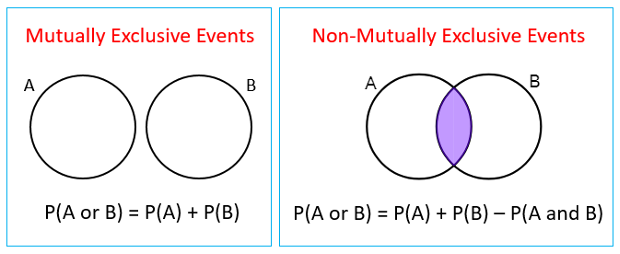
3. Probability of Union of Events
Union = probability that A or B occurs.
- Mutually exclusive events (cannot happen together): P(A∪B)=P(A)+P(B)
- Non-mutually exclusive events (can happen together): P(A∪B)=P(A)+P(B)−P(A∩B)
4. Probability of Intersection of Events
Intersection = probability that A and B both occur:
P(A∩B)=P(A)⋅P(B/A)
If A and B are independent: P(A∩B)=P(A)⋅P(B)
This is often called the multiplication law of probability
Example: Suppose you are going to USA from Bangladesh using a transit in Dubai. From Bangladesh probability of getting the available ticket of “Amirates Air” is 0.7 and from Dubai to USA probability of getting ticket of “Amirates Air” is 0.4. What is the probability that your travel is Dhaka to Dubai via Amirates Air and Dubai to USA also Amirates Air?
Here
A= Amirates Ticket from Dhaka to Dubai = 0.7
B= Amirates Ticket from Dubai to USA = 0.4
Event A and B are independent. So P(Dhaka to Dubai via Amirates Air and Dubai to USA also Amirates Air) is P(A∩B)
P(A∩B) = P(A)⋅P(B) = 0.7 * 0.4 =0.28
Another Example: Table in the following shows customers gender and and their purchase status. From a dataset this table were generated. Let our interest is on Male who bought so we can define events as
A= Male and B= Buy
|
|
Buy |
Not Buy |
Total |
|
Male |
6 |
4 |
10 |
|
Female |
14 |
6 |
20 |
|
Total |
20 |
10 |
30 |
P(Male) = 10/30; P(Female) = 20/30; P(Buy) = 20/30; P(Not Buy) = 10/30
i.e. P(A) = 10/30; P(Ac) = 20/30; P(B) = 20/30; P(Bc) = 10/30
P(B/A) = P(Buy within Male) = Male and Buy/Total Male = 6/10
i.e P(B/A) = P(A ∩ B) / P(A)
=> P(A ∩ B) = P(A)⋅P(B/A)
5. Conditional Probability Probability of A given B has occurred:
P(A/B)=P(A∩B) / P(B) given P(B) ) ≠ 0
6. Total Probability Rule
If events B1, B2, ..., Bn form a partition of the sample space:
P(A)=P(A∩B1)+P(A∩B2)+⋯+P(A∩Bn) or
P(A)= P(A / B1) . P(B1) + P(A/ B2) . P(B2) + ……. + P(A / Bn). P(Bn)
Example: Let our interest is on Male who bought, so we can define events as
A= Male and B= Buy
|
|
Buy |
Not Buy |
Total |
|
Male |
6 |
4 |
10 |
|
Female |
14 |
6 |
20 |
|
Total |
20 |
10 |
30 |
P(Male)=P(Male ∩ Buy) + P(Male ∩ Not Buy)
i.e. P(A) = P(A ∩ B) + P(A ∩ BC) = 6/30 + 4/30 =10/30
i.e. P(A) = P(A).P(B/A) + P(A). P(A ∩ BC) = 10/30 . 6/10 + 10/30. 4/10
= 6/30 + 4/30 = 10/30
7. Addition Rule for Three Events
P(A∪B∪C) = P(A) + P(B) + P(C) − P(A∩B) − P(A∩C) − P(B∩C) + P(A∩B∩C)
P(A)= P(A / B1) . P(B1) + P(A / B2) . P(B2) + ……. + P(A / Bn). P(Bn)

Feedback
ABOUT
Statlearner
Statlearner STUDY
Statlearner